Find, compare and buy robots from top manufacturers
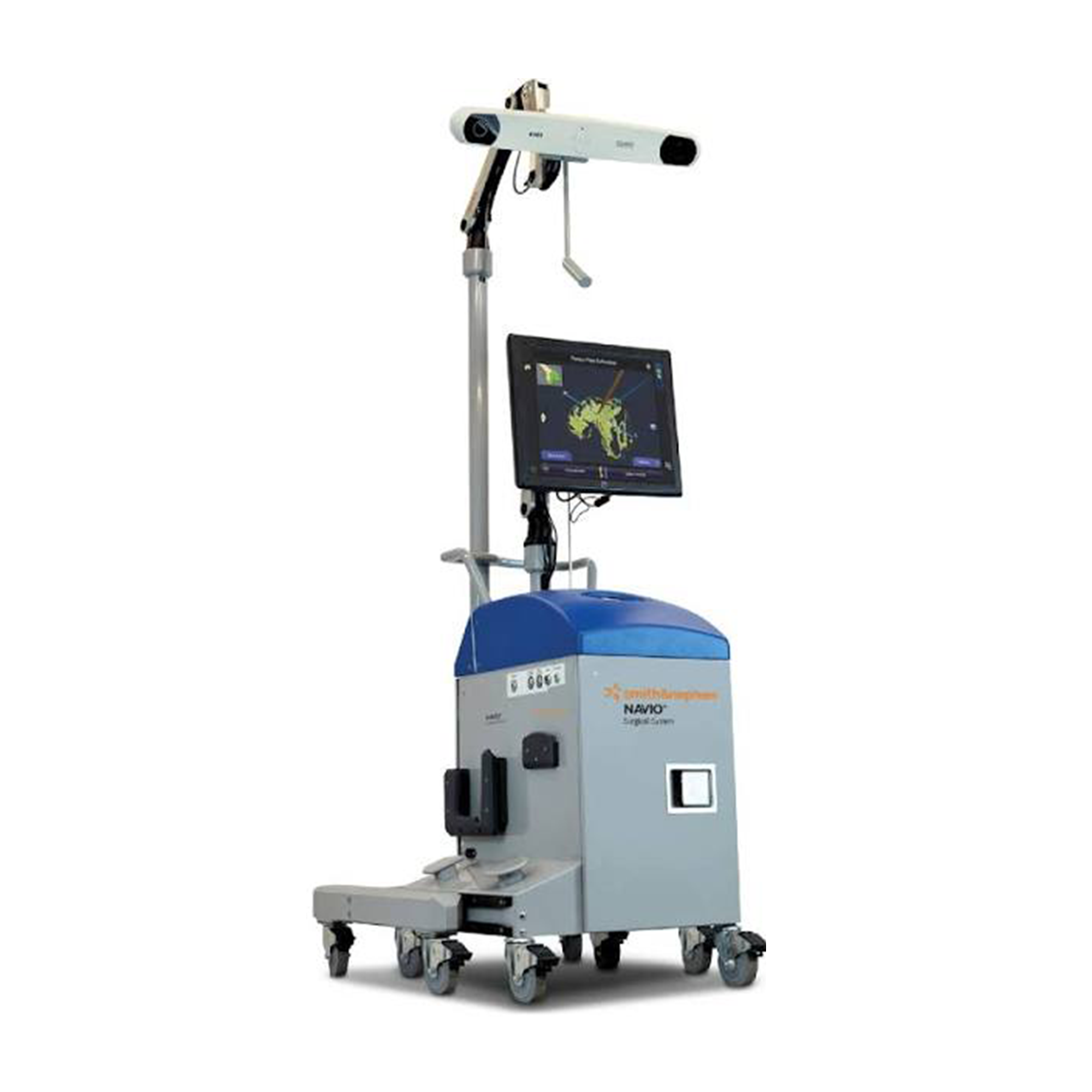
The Smith+Nephew NAVIO is a handheld robotic-assisted system developed for image-free planning and bone preparation in partial and total knee replacement.

Get quotes in 24–48 hours

Verified suppliers & secure process

Transparent pricing & guidance


The Smith+Nephew NAVIO is a handheld robotic-assisted orthopaedic surgery platform developed for partial and total knee replacement workflows.
It combines image-free intraoperative mapping, patient-specific planning, real-time tracking, and a surgeon-controlled handheld cutting tool designed to support accurate bone preparation without requiring a preoperative CT scan.
NAVIO is best understood as the previous generation of Smith+Nephew handheld robotics and is most relevant to hospitals with an installed system, service requirements, used-equipment evaluations, or a need to compare the platform with the current CORI generation.
As a previous-generation platform, NAVIO remains most relevant to existing installations, service planning, training, and used-system evaluation where condition, support status, and compatibility can be confirmed.
Surgeon-controlled handheld instrumentation supports targeted bone preparation.
Builds the surgical plan from intraoperative anatomy rather than requiring a preoperative CT scan.
Allows patient-specific planning and assessment during the procedure.
Developed for partial and total knee replacement workflows under applicable approvals.
NAVIO preceded the smaller and faster CORI Surgical System.
Still relevant for service, lifecycle, training, parts, and used-equipment evaluations.
Orthopaedic robotic-assisted surgery system
Image-free knee arthroplasty
Hospital operating rooms
Portable OR deployment
Not a load-handling system; the handheld instrument is procedure-specific
Handheld; no fixed arm reach
Portable clinical system
Surgeon-controlled handheld bone-preparation tool
Not publicly specified
Not publicly specified
Not publicly specified
Image-free planning + surgeon control
Not publicly specified
Not publicly specified
Not publicly specified


The Smith+Nephew NAVIO price is generally available only through a medical-equipment quotation, and current transactions are more likely to concern installed, used, refurbished or legacy inventory than a standard new-system catalogue sale. The value depends heavily on age, software, included handpiece and instruments, service history, regional support, installation and whether Smith+Nephew will support the exact serialised system. The final cost can change with country, configuration, accessories, installation, training, service coverage, shipping, taxes and any application-specific equipment.
Buyers should therefore compare the complete delivered and deployable package rather than a headline number. For hospitals, orthopaedic departments, biomedical engineering teams and specialist medical-equipment procurement organisations, the important questions are what is included, what must be purchased separately, who is responsible for commissioning and who provides support after installation.
A used-system price is not meaningful unless the buyer confirms software rights, calibration, accessories, service eligibility and the cost of returning the system to clinical use. Ask the seller to separate capital hardware, recurring software, consumables, optional tools, freight, site work, training and annual service so proposals can be compared on the same basis. Also confirm the quotation currency, validity period, payment milestones, estimated lead time and whether taxes or import charges are excluded.
You can request a Smith+Nephew NAVIO quote through Anton Robots to compare whether the system is new, used or refurbished, software generation, approved knee applications, instruments, handpiece, tracking equipment, service eligibility, installation, training and comparison with CORI before making a purchasing decision.
You can buy, source or request the Smith+Nephew NAVIO through Anton Robots, depending on the product’s current commercial status and your region. Anton Robots helps buyers compare suppliers, confirm availability, understand the proposed package and decide whether the Smith+Nephew NAVIO fits the intended use case. New orthopaedic robotics enquiries should normally be directed to Smith+Nephew and its current CORI portfolio; NAVIO opportunities require explicit confirmation of legacy inventory and support. Not every offer is equivalent: one proposal may cover only the core system, while another may include application hardware, software, installation, training, warranty handling, spare parts and ongoing service.
Before committing, confirm the exact model or generation, included components, delivery destination, regulatory or site requirements, commissioning responsibilities and support route. This is especially important for hospitals, orthopaedic departments, biomedical engineering teams and specialist medical-equipment procurement organisations. Ask whether the seller is authorised for the destination market, whether the warranty remains valid there and who will perform installation or repairs. Obtain an itemised written proposal rather than relying on a marketplace title, product photograph or verbal promise.
To begin, request a Smith+Nephew NAVIO quote and Anton Robots can help compare the complete purchase or deployment package.
You can look for the Smith+Nephew NAVIO for sale through the manufacturer, authorised regional partners, specialist suppliers and robot marketplaces such as Anton Robots. NAVIO is the predecessor to CORI and should be treated as a legacy platform. Used or refurbished listings may exist, but they do not establish current manufacturer support. Finding a listing is only the first step. The safer comparison is the total delivered and operational cost, including the exact generation, hardware configuration, software access, required accessories, freight, installation, training, warranty, service and any local compliance work.
A low advertised figure may exclude equipment that is essential for the intended workflow. For hospitals, orthopaedic departments, biomedical engineering teams and specialist medical-equipment procurement organisations, supplier capability and post-sale support can matter as much as the system itself. Where used, refurbished or old-stock equipment is involved, request the serial number, manufacturing date, maintenance history, software status, ownership documentation and written confirmation that parts and service remain available. Do not assume that a historic product page means the same configuration is still manufactured or supported.
If you are looking for a Smith+Nephew NAVIO for sale, contact Anton Robots before ordering so the current commercial status and package can be checked.
Yes. You can get a quote for the Smith+Nephew NAVIO through Anton Robots. A useful quote should show more than the base equipment price. It should identify the exact system version, included hardware, software or licences, accessories, installation assumptions, training, freight, warranty, expected lead time and service coverage. For this product, the quote should specifically address whether the system is new, used or refurbished, software generation, approved knee applications, instruments, handpiece, tracking equipment, service eligibility, installation, training and comparison with CORI.
This matters because two proposals carrying the same product name can represent very different deployable solutions. Before requesting pricing, define the application, country, site, expected usage, integration needs and required support level. Include any deadline, facility constraints, user numbers, required documentation and acceptance criteria. Ask the supplier to list exclusions and optional items separately and to state what must be supplied by the buyer or a third-party integrator.
Anton Robots can help compare the Smith+Nephew NAVIO with other surgical robots and prepare a request based on the real project rather than an incomplete base configuration.
A typical Smith+Nephew NAVIO package may include the core system and the standard components listed for the selected configuration, but the exact scope varies by seller, region and project. Before buying, request an itemised packing and services list. Confirm whether the proposal includes:
For legacy equipment, serial number, service records, software version, calibration status, remaining instrument compatibility and transferability of licences are essential.
This matters because the robot or platform may be only one part of the working solution. Software, tools, consumables, site preparation, integration, validation and support may be separate. Ask which components are required for basic operation, which are application-specific, which are consumable, and which carry their own warranty or licence. The proposal should also identify quantities, model numbers, software terms, documentation, installation responsibility and anything shown in demonstrations but excluded from the standard package.
You can request an itemised Smith+Nephew NAVIO package quote through Anton Robots before purchase.
The Smith+Nephew NAVIO may be supplied internationally, but shipment and deployment depend on the manufacturer or partner network, destination country, product status, transport restrictions and local requirements. Any transfer of medical equipment requires specialist handling, installation, electrical and technical inspection, and confirmation that the destination hospital can lawfully and safely place it into service.
Buyers should confirm whether freight, insurance, customs clearance, import duties, taxes, site delivery, installation and commissioning are included or charged separately. For complex systems, delivery may involve multiple crates, specialist handling, site preparation or an installation team rather than ordinary parcel shipping. Also check packaging dimensions, battery or hazardous-goods rules, electrical standards, language documentation, import permits and responsibility for damage in transit. A delivered unit may still be unusable until software, calibration, networking, training or formal acceptance is complete. Do not compare only the factory or advertised price.
If the Smith+Nephew NAVIO is needed outside the seller’s home market, request an international or regional quote through Anton Robots so availability and landed project costs can be checked.
Smith+Nephew NAVIO availability and delivery time can change by country, system generation, configuration, production capacity, partner coverage and project requirements. NAVIO is no longer Smith+Nephew’s primary new robotic platform; current buyers should compare CORI and verify whether any NAVIO unit is supported in their market. A website page, brochure or historic listing does not by itself prove that a new unit is immediately orderable.
Before planning a launch, course, clinical programme or operational deployment, ask whether the quoted system is new, current-generation, refurbished, demonstration stock, legacy stock or supplied as part of a managed project. Also confirm expected manufacturing, shipping, installation and acceptance timelines. Request the availability statement in writing and distinguish stock on hand from a supplier estimate, factory allocation or unit that has not yet been configured. Accessories, software licences, specialist staff, regulatory paperwork or site works can create a longer critical path than the hardware itself. Build contingency into any public opening, semester, procedure launch or production deadline.
You can request current Smith+Nephew NAVIO availability through Anton Robots before committing to a deadline.
Before buying the Smith+Nephew NAVIO, confirm the warranty period, covered components, exclusions, service-response process, preventive-maintenance requirements, software support and spare-parts availability. Legacy status makes authorised service, spare parts, software access, handpiece maintenance, calibration and cybersecurity support particularly important. Ask who provides first-line support, whether technicians are available in your region, how faults are diagnosed, what happens if a critical component fails and whether operator or technical training is included.
For professional, educational, clinical or industrial use, support should be evaluated as part of the product rather than as an afterthought. Request service hours, response targets, remote-support terms, travel charges, loan-unit or replacement policy, update entitlement and expected parts lead times. A lower purchase price can be a poor trade if local service, updates or replacement parts are unavailable.
Contact Anton Robots to review warranty and support terms within the proposed package.
The Smith+Nephew NAVIO can be worth buying when its capabilities, commercial status and support model match the intended application. It may remain valuable for an established hospital programme, training, lifecycle planning or a carefully verified used-system acquisition where support is available.
However, it is not automatically the right choice for every buyer. For a new robotic orthopaedic programme, the current CORI generation is generally the more relevant Smith+Nephew platform to evaluate. The decision should consider workflow fit, required accessories, integration effort, safety or regulatory obligations, training, service access and total lifecycle cost. For hospitals, orthopaedic departments, biomedical engineering teams and specialist medical-equipment procurement organisations, a technically suitable system with clear support is usually more valuable than the lowest initial price.
Compare the Smith+Nephew NAVIO with other surgical robots and request project-specific advice through Anton Robots before buying.
Smith+Nephew now positions the CORI Surgical System as the current generation of its handheld robotic platform, and NAVIO is best treated as a legacy or previous-generation system. That does not mean every installed NAVIO unit immediately stopped operating. Hospitals may still have systems in service, and used or refurbished equipment may appear on the market.
However, buyers should not infer current support from an online listing. Confirm the exact serial number, software version, local regulatory status, service eligibility, parts availability, handpiece support and instrument supply directly with Smith+Nephew or an authorised service organisation.
For a new programme, compare CORI before considering a legacy NAVIO acquisition. For procurement, verify the exact regional labelling, system generation, enabled software and manufacturer documentation for the Smith+Nephew NAVIO. The hospital’s clinical governance, biomedical engineering and procurement teams should review the proposed use together before a contract is signed.
The NAVIO system was developed for robotic-assisted partial and total knee replacement workflows, subject to the approved indications and implant compatibility in the relevant market. It used intraoperative mapping and patient-specific planning to help the surgeon prepare bone with a handheld robotic tool.
The system did not make clinical decisions or perform the procedure autonomously. A hospital evaluating an installed or used NAVIO should confirm which applications are enabled in the software, which Smith+Nephew implant systems are supported, whether the instruments remain available and whether the current labelling permits the intended procedure in that country.
Any clinical workflow must be implemented through authorised training, credentialing and local policy. A feature described in another country or on a different software version should not be assumed to apply to the exact Smith+Nephew NAVIO configuration being purchased.
NAVIO was promoted as an image-free robotic-assisted surgery system. It created a three-dimensional representation and surgical plan from anatomical data collected during the operation rather than requiring a separate preoperative CT scan for the standard workflow.
This can remove CT scheduling, radiation and image-transfer steps, but it does not eliminate the need for clinical imaging or surgeon planning where otherwise indicated. The surgeon remains responsible for registration accuracy, planning, implant selection and execution.
Buyers should confirm the software version and approved workflow on the exact system being evaluated. Ask the supplier to demonstrate this capability using the intended procedure and to identify required instruments, accessories, software and recurring items. The written quote should state what is standard, optional and subject to separate regulatory approval.
CORI is Smith+Nephew’s newer handheld robotic platform and was introduced as a more compact and faster evolution of the technology used in NAVIO. Both use an image-free approach and surgeon-controlled handheld bone preparation, but they differ in hardware, software, footprint, workflow, supported applications and current commercial support.
NAVIO should not be priced or purchased as though it were identical to CORI. Hospitals should compare current indications, implant compatibility, handpiece performance, planning tools, service coverage, upgrade path and training.
A low-cost legacy NAVIO may be less attractive if support, software or instruments cannot be secured. The system remains an assistive medical device under clinician control. Risk assessment, emergency procedures, cleaning or sterile processing, maintenance and incident escalation must be defined before patient use.
Used NAVIO systems may appear through medical-equipment resellers or asset disposals, but a hospital should buy only after a documented technical, regulatory and service review. Check title and ownership, serial number, maintenance records, software licences, cybersecurity status, instrument and handpiece condition, calibration, decontamination records, transport requirements and whether Smith+Nephew will support the system at the destination.
The purchase price may exclude recommissioning, parts, software, training and clinical validation. Anton Robots can help identify questions for the seller, but the system must be approved by the hospital’s procurement, biomedical engineering, infection-control and clinical governance teams.
Service coverage is critical because downtime can affect theatre schedules and patient pathways. Confirm preventive maintenance, field-engineer response, software updates, cybersecurity, spare parts and the training route for new staff.
No. NAVIO is a surgeon-controlled robotic-assisted tool. The surgeon plans the bone preparation and physically guides the handheld instrument. The system provides tracking and control intended to keep the preparation within the planned boundaries, but it does not diagnose the patient, select the implant or independently conduct the operation.
A trained orthopaedic surgeon and full clinical team remain responsible throughout. This distinction matters because the word robot can suggest autonomy that the platform does not have. Compare alternatives using the same procedure mix, staffing model, room time, instruments, service and recurring cost. A demonstration alone cannot establish clinical value or total cost of ownership.
Before restarting or extending a NAVIO programme, check the system service status, software version, calibration, handpiece condition, tracking equipment, instruments, implant compatibility, cybersecurity, staff competency and local approval. Review maintenance and fault history, confirm access to authorised technical support and establish whether replacement parts and consumables remain available.
The hospital should also repeat clinical governance, risk, infection-control and training reviews if the system has been inactive or moved. A successful power-on test is not enough to establish clinical readiness.
Anton Robots can help structure the commercial enquiry, but the manufacturer and hospital must confirm clinical suitability, current approval, training and the final configuration. Medical decisions remain with qualified healthcare professionals.
Tell us what you need. Our experts will help you find the right robot for your business.
Browse Robots
Humanoid Robots
Robot Dogs
Robotic Arms
Cobots
AMR Robots
AGV Robots
Service Robots
Companion Robots

